Building DSA as an Organization of Organizers

The injunction to “organize” on the Left has become ubiquitous, even banal. What exactly is meant by “organizing” is extraordinarily nebulous, potentially describing any kind of political work from electoralism to community gardens. The theoretical task of organizers, then, is to turn vague ideas into clear conceptions of action.
Drawing on the Communist Caucus’s thesis of proletarian disorganization, I argue that the primary task of the socialist organizer is to cultivate the agency and collective capacity of our coworkers and neighbors in order to build a militant nucleus of both new and reinvigorated institutions of working-class power. Disorganization is not only understood quantitatively: an Organizer operates under the hypothesis that lived experiences of collectively fighting authority on the terrain of everyday life shifts peoples’ political horizons and engenders a militant class subjectivity that affirms in action that another world is possible.
In this paradigm, the Organizer refuses an overly schematic distinction between the “political” and the “economic,” something transplanted from the early 20th century Russian soil of absolutist monarchism , because, as the sociologist Panagiotis Sotiris says, “there is no purely economic relation of exploitation.” Rather, exploitation itself always requires, and implies, a relationship of domination–even when it is not obviously active within the experience of exploitation, force is always behind the scenes, or waiting patiently off-stage. While the Organizer seeks to leverage worker power–in and out of unions and other formal organizations–for broader social struggles, such as Palestine solidarity, she does so by (to quote Notes from Below’s report on the Autonomous Collective of Dockworkers in Genoa) “tackl[ing] questions of labour and politics in the same manner — as part of the same fight.”
In the two years since this essay’s publication, the two alternate approaches identified — a right opportunism that substitutes even basic forms of class struggle with dedicated cadre politicians advocating on behalf of a disorganized working class, and the left DSA strategy of politics as a programmatic endorsement of revolutionary strategy — have become more sophisticated.
The former strategy, after years of setbacks, has been reinvigorated by the striking victory of Zohran Mamdani. Interestingly, many of our electorally minded comrades claim to agree with the thesis of disorganization. However, when these comrades speak of fighting disorganization, they remain ambivalent about the autonomous action of the working class, and instead focus on building an electoral constituency that can be counted on to vote for progressive politicians (or in the case of the more politically developed, to canvass for them). It is hoped that proletarian self-activity will trickle down, but it must then be subordinated to a top-down legislative strategy, an inside-outside strategy where the “outside” is practically just an alibi. It is undoubtedly true that prominent electoral campaigns, such as Zohran Mamdani’s, can catalyze new organizing, but even the most dedicated and principled elected official cannot substitute themselves for the activity of self-organized people. Electoral campaigns can also be profoundly depoliticizing in their cultivation of demobilizing parasocial loyalties, which replace strategic deliberation with ferocious debates over the moral character of a particular politician.
For proponents of the left DSA strategy, the primary problem is not concentration of proletarian self-activity, but transmission of a larger political goal (the analysis of whatever 20th century socialist tendency the particular comrade prefers) to local fights. Therefore, the primary goal of the Organizer is to “politicize” economic struggles, understood as recruiting to DSA and pushing a particular line. The issue is that if the “political” is defined by being intrinsically eccentric to the workplace, it will struggle to find its footing on the shop floor itself, reducing political struggle to proselytization. Instead, the Organizer ought to identify how wider social struggles are experienced by their coworkers, and then take concrete collective action with others: for instance, Starbucks baristas organizing for gender-affirming care, or STEM researchers rejecting complicity in Israel’s genocide in Gaza.
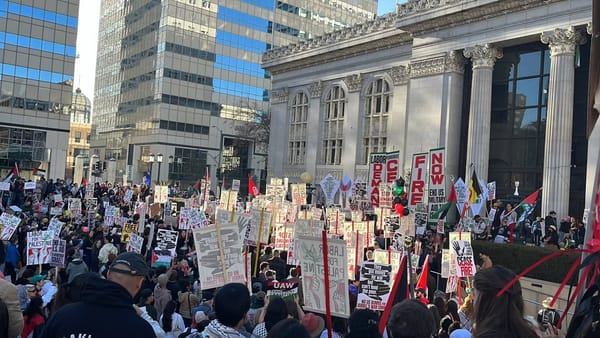
Both of these other paradigms for organizing come as responses to a striking conjunctural development: millions of young people identifying with “democratic socialism,” and the historic (though comparatively modest) growth of the DSA. At the time of writing this piece, DSA was in a membership crisis, which has fortunately reversed as the social movements that had ebbed in the early Biden years became reinvigorated in response to the genocide in Gaza and second election of Trump. Still, this growth so far has engendered a paradigm for militancy that is extraordinarily passive. For most, organizing in the DSA means canvassing, attending political meetings to give or listen to speeches, writing solidarity statements, and, at its worst, being active in an insular social scene that primarily plays out on social media. The wager of what Commie Caucus calls “doing politics at the base” is that it builds the mass protagonism necessary for the political recomposition of the class as a whole, as well as invigorate an associational culture that can sustain struggles on the terrain of the everyday and activate a broader cross section of the class than DSA has thus far. The true potential of the DSA is not a progressive nonprofit or the fantasy of a fetishized revolutionary party (which even in its most cogent articulations relies on an extraordinarily vague sequence of crisis followed by seizing power), but as a scaffolding for members to engage in struggles where they live and work, connect militants across distinct fights, and to use these experiences to reflect on and refine our answers to the difficult questions of our conjuncture.
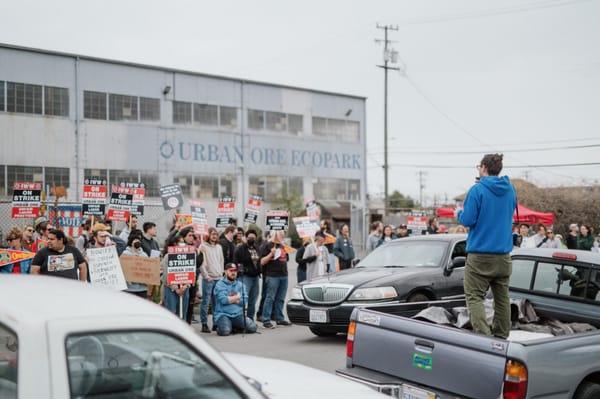
The paradigm for organizing described below is a wager. In the last two years since this essay's initial publication, comrades in Communist Caucus and affiliated militants have played a humble role in testing its assumptions, both inside and outside DSA, through building local Emergency Workplace Organizing Committee branches, supporting tenant struggles as part of the Housing Justice Commission, and helping launch what can only be described as a “political strike.” Of course, none of these efforts by themselves are groundshaking. But they are indications of where the beachheads for a fighting socialist movement might be established, and indicate an approach to political work that, if generalized, might make us a real –even potent– force in the world. The hypothesis here — that there is no working class waiting in the wings to be mobilized with the right campaign or slogan, that organizing on the terrain of the everyday engenders new forms of militant subjectivity, and that DSA can play a critical role in building fighting institutions of class power — can, despite some of these early successes, only be proven or disproven through the tests of class struggle.
August 3, 2023: In Prisoners of the American Dream , the late Mike Davis wrote that each cycle of class struggle sets the “objective conditions of accumulation“ and “subjective capacities of class organization” in the next period. Our moment, using Davis’s analysis, is circumscribed by what the Communist Caucus has collectively defined as the problem of “proletarian disorganization”: the hollowing out of traditional institutions of class power existing in everyday life and associated habits of organized struggle. As the defining problem of our moment, proletarian disorganization has, within our lifetimes, severely limited what is politically possible for the DSA and the Left broadly.
The Trump years saw the unique eruption of militant social movements and a related phenomenon of self-identified “democratic socialists” being elected to public office. Remarkably, despite the energy behind these ruptures, very little remains organizationally. The remnants of these movements are cohered in a network of nonprofits stuck in the sisyphean tasks of legislative advocacy- taking those demands once made in mass movements and turning them into easily digestible policy soundbites to be presented to politicians. The role of the class struggling for itself has been replaced by a few NGO staffers mobilizing dwindling numbers of activists.
Just a few years ago the DSA approached 100,000 members but is now hemorrhaging by tens of thousands. In the post-Bernie, post-uprising moment, DSA must make a stronger political case for members to stay involved.
The post-Bernie DSA’s political practice has crystallized into legislative advocacy, most notably in NYC-DSA’s “Albany strategy” which prioritizes the election of DSA cadre into State assembly and Senate in order to, at least theoretically, advance the project of “non-reformist reforms.”
Recognizing the limits imposed by proletarian disorganization, proponents of this strategy try to substitute class struggle with policy advocacy from elected officials and their staff. In New York’s Socialist in Office (SIO) committee, electeds have on several occasions bowed to pressure from Democratic Party leadership, such as elected State Senators not endorsing NYC-DSA’s full electoral slate in 2022 after being threatened with removal from committees if they did so. Albany strategy partisans argued that appeasing establishment politicians was necessary to pass key reforms, specifically “Good Cause” protections for tenants, which in the 2023 legislative session failed to pass for the fourth year in a row. This insider strategy to win reforms eschews publicizing these threats to agitate a base of constituents, does not organize the class, and often even fails to deliver on the reforms it promises.
Most of NYC-DSA’s legislative priorities have ended in defeat. In the few legislative fights the chapter has won, it only did so as part of a far more politically heterogenous coalition, thus limiting the organization’s advocacy to what liberal nonprofits will support. Far from the original goal of “non-reformist reforms”, DSA socialists in office can only achieve a degree of success by formally cohering itself as the progressive wing of the Democratic Party, a strategy that works against the project of working class self-emancipation. This is not to advocate for complete electoral abstentionism, but rather to recognize the real limits of a strategy that views legislation as the primary terrain of struggle for the movement.
Another political practice in the organization, rising in opposition to the right-wing of DSA, wraps itself in the symbols of defeated 20th century revolutionary movements. This “left of DSA” tends to valorize past organizational forms, namely a bolshevik style party, without serious consideration of distinct political contexts. As such, these comrades hyperfocus on the struggle for the correct line in internal political fights and too often fall into the trap of a “resolutionary socialism” that neither builds the class nor successfully advances communist politics within the organization. The challenges of our moment cannot be adequately addressed by the DSA adopting the right line, even by declaring ourselves communists, but by building “an organization of organizers.”
Such an organization of organizers would work to build institutions of class power in order to produce what Viewpoint editor Bue Rübner Hansen called the “continued production of solidarity in the everyday.” The social atomization and alienation inherent in capitalism reifies everyday exploitation and oppression as a natural reality rather than as something socially constructed and thereby subject to change.In order to fight this demobilizing ideological paradigm, it is not enough to proselytize socialism. We should instead build organizations that develop working class people into organizers themselves. Instead of limiting the terrain of political practice to the bourgeois state apparatus or insisting politics must involve the exhaustive preaching of a “revolutionary” line, we must conceptualize a “new practice of politics” based in autonomous organizations of the working class. Through building such organizations on the terrain of the everyday, we engender a new politicized subjectivity and affirm in action Alain Badiou’s “communist hypothesis” that the existing world is not necessary.
Labor and tenant unions, which organize collectively against a shared exploiter, deserve particular focus as institutions of class power. While unions have suffered from decades of disorganizing offensives, they still represent the primary source of organized working class political subjectivity for millions of American workers. Whereas the Left broadly has suffered from a disorganizing malaise after 2020, the labor movement is advancing on new fronts with new union drives happening at Starbucks, the ongoing WGA & SAG strike, and the Teamsters militantly organizing for contract demands. Tenant unionism is on the rise as well with neighborhood and citywide unions cohering in cities such as LA, Boston, Kansas City, Chicago, Oakland, and New York. The DSA can support such initiatives by investing members’ ability to organize where they live and work, through projects like the rank-and-file strategy, EWOC (the Emergency Workers Organizing Committee), and ETOC (Emergency Tenants Organizing Committee).
Labor and tenant unions also provide new strategic options for the movement in moments of social rupture. In Hammer and Hope’s reflections on the 2020 uprisings, philosopher Olúfẹ́mi Táíwò argued that unions have unique advantages in popular struggles given their ability to democratically decide on demands and withhold labor if those demands are not met. A key lesson from the defeats of 2020 is that mass marches and theatrical direct actions, while important tactics, cannot enact revolutionary change by themselves without being able to draw on existing institutions and networks of class power. Our task can be understood as an oscillating war of maneuver in moments of rupture and war of position, where our role is to build up working class organization to be ready for those periods, based on the particular political moment.
There are two reductive approaches on the Left to labor and tenant organizing. The first claims union work should be prioritized as “class first” organizing rather than what is considered frivolous identity politics. The second claims a focus on building working class institutions is “economistic.” The former is a chauvinistic misunderstanding of how united class solidarity forms: the struggle for universal class liberation is necessarily built from particular emergent struggles against exploitation and oppression acting in solidarity with each other. To draw from abolitionist scholar Ruth Wilson Gilmore’s reflections on anti-carceral organizing, opposition to a prison being built in a particular community often begins with “not in my backyard”, a place-based identity that can be either progressive or reactionary, but through the experience of struggle is transformed into “not in anyone’s backyard”- in other words, true universalism built out of particularity.
The latter argument draws on a restrictive view of organizing as a series of mostly unrelated issue areas instead of as a means to connect and scale up political struggles. In the labor movement for example, anti-racist and feminist struggle is key, both inside and outside the union, from Amazonians United successfully fighting back a racist anti-union campaign, Newsguild workers at the NY Times advocating against their employer’s transphobic coverage, or the thousands of starbucks workers who went on strike for the ability to openly celebrate Pride in stores. In the tenant movement, it is impossible to do any successful organizing without immediately confronting gentrification and the displacement of black tenants by the landlord class. The category of “tenancy” also creates a precarious relationship to housing and the possibility of criminalization and so, tenants organizing together in our unions directly confront oppressive realities of private property, racist displacement, anti-houseless sweeps, and the carceral state.
Building an organization of organizers will also involve experimenting with new strategies and organizational forms on the terrain of the everyday. Given the pervasiveness of the carceral state in everyday life, abolitionist organizing provides a key opportunity to experiment with new forms of community base-building. In several places, local abolitionist collectives, such as the Crown Heights Care Collective in Brooklyn, have worked hand-in-hand with the tenant movement as part of a shared struggle for community control over neighborhoods.
Ultimately, these last six years are a case study in how proletarian disorganization severely limits the Left’s ability to pass and enforce reforms, “build power” both in and outside of electoral politics, hold socialists in office to their commitments, and rely on a mass base of support beyond a homogenous group of mostly white professional activists. Without the institutions of class power that can articulate and engender specific subjectivities in its members, the Left is limited to being a junior partner in a liberal coalition and/or a statement writing collective with a Twitter following. There is no working class waiting in the wings to be mobilized with the right electoral campaign or slogan. The class must instead be built for and by itself.