“The Workers Lead, We Support Them”
Three years of the East Bay Workplace Organizing Committee: Eighteen unionized shops and 2,000 workers with a union — what comes next?
In 2022, members of Communist Caucus in East Bay DSA (EBDSA) asked ourselves a series of questions: How can DSA make a meaningful contribution to building proletarian organization in the East Bay? Why don’t we have much connection to the surge of new union organizing happening locally and nationally? How can our labor work help develop DSA members into organizers?
At that time, the two main ways that an EBDSA member could engage in external-facing labor work were labor solidarity, usually in the form of picket line support for striking local workers, and our chapter jobs program, which helps socialists get jobs in strategic workplaces.
Labor solidarity work was mostly reactive, limiting its ability to develop relationships and organizers. Whether there was meaningful work to do depended on whether a union decided to strike and how long that strike lasted. The jobs program, on the other hand, asked people to change career trajectories, in some cases for low-paying jobs in non-union industries — an important but major “ask” that most DSA members are not going to undertake.
Both of these efforts have yielded impressive successes and will continue to do so. But the East Bay Workplace Organizing Committee, which was founded in the fall of 2022 as part of EBDSA’s Labor Committee, has proven to be a uniquely self-sustaining and successful project among our chapter’s labor efforts.
As communists, our initial questions when building EBWOC ranged from grand strategic and political debates about the labor movement that have long animated the international Left to immediate practical matters. Despite our widely shared understanding of the limitations of the “official” American labor movement and the National Labor Relations Board election system, rather than directing workers toward a solution like independent or new unions, our most experienced comrades guided us toward what became our points of unity:
- The workers lead, we support them.
- We share our honest opinions about different organizing strategies, including ones from labor history.
- We don’t hide that we are socialists, but we don’t preach.
- We prioritize the perspectives of rank-and-file workers over union staff.
- We support all workplace organizing, even if it may not lead to unionization.
When EBWOC was founded, the national Emergency Workplace Organizing Committee (EWOC) agreed that all leads in the East Bay would be referred first to our local team. EWOC itself was co-founded by DSA and UE during the pandemic, on the premise of getting support to workers reaching out for help within 24 hours – regardless of industry or the likelihood of a successful union drive.
While East Bay was not the first “local EWOC,” it was the first that stayed afloat while prioritizing this model of supporting local workers. After additional locals got off the ground in St. Louis DSA and Santa Cruz DSA, this model was approved by DSA’s National Convention in 2023 and implemented with ongoing support from EWOC.
Since EBWOC was founded in the fall of 2022, workers at more than 140 employers have reached out to us for support and been connected with an organizer. Of those initial contacts, 18 EBWOC-supported shops representing over 2,000 workers went on to win their union election or voluntary recognition. These victories include campaigns in the healthcare, grocery, higher education, service, retail, and nonprofit sectors, involving workers at national employers like Planned Parenthood, Trader Joe’s, and Starbucks, in addition to local businesses like Urban Ore, Highwire Coffee, and Good Vibrations.
We lead in-person trainings for union and non-union workers, running both classics like how to have an organizing conversation and more pressing interventions like how to organize around the threat of ICE raids in the workplace. Our trainings have connected us to successful organizing committees and workers who directly applied their content.
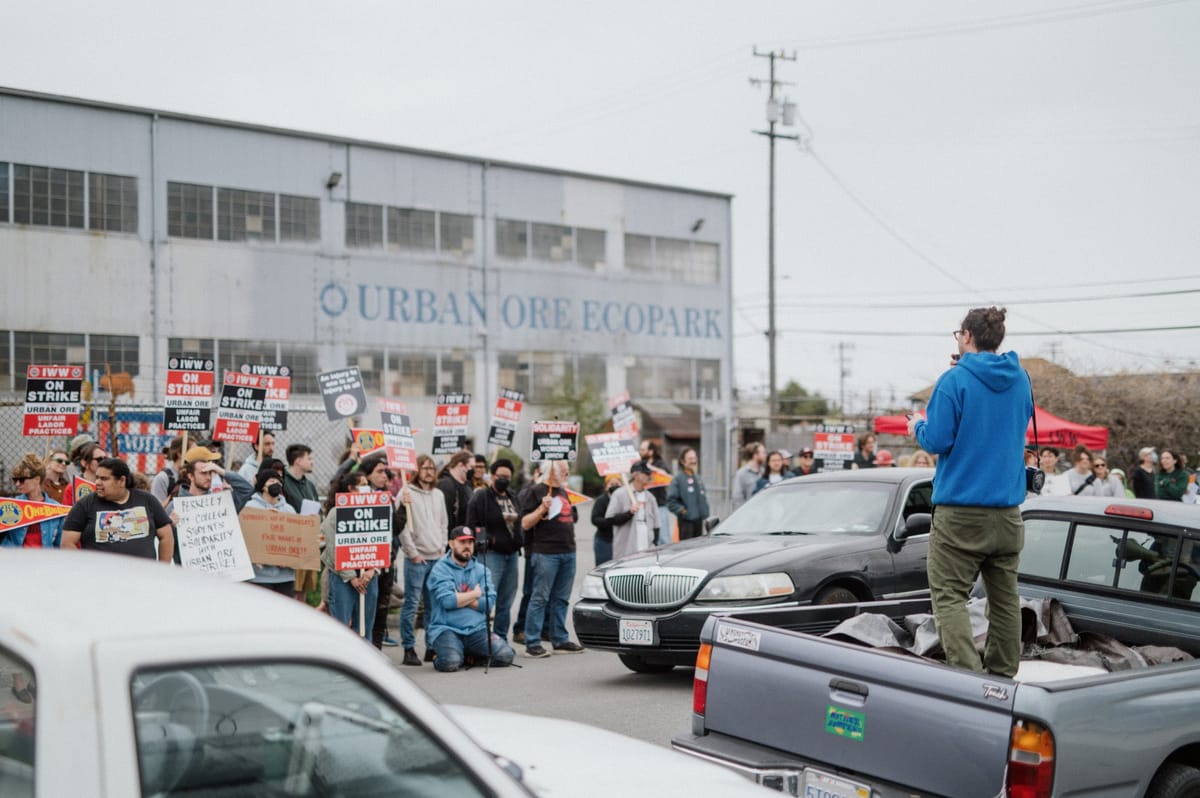
We continue to support workers even after they win recognition (so long as they are interested in support) — something not all local EWOCs have the capacity to do. Most notably, EBWOC and East Bay DSA organized significant aspects of the community picket support during the six-week strike at Urban Ore earlier this year, and helped raise about $10,000 for their strike fund via fundraising parties and donations. The strikers ultimately won a number of impressive victories and a first contract that increased wages, protected their right to strike, provided more generous leave, and reinstated wrongly terminated strikers.
Volunteer organizers consistently show up and take on work, learning and teaching each other, whether they have decades of experience in the labor movement or EBWOC is the first time they’ve gotten involved in workplace struggles. In the last couple of months, 40 volunteers have attended an EBWOC meeting, taken an assignment to support a worker, performed administrative work, or otherwise supported the project. Some workers have joined DSA and/or EBWOC after receiving support from us, and many of our volunteers joined DSA because they want to organize with EBWOC.
EBWOC leadership treats EBWOC like an organizing committee — constantly seeking out and recruiting people inside and outside of DSA who seem like they would be good workplace organizers or are already supporting worker organizing drives in the East Bay. This sort of leadership identification mirrors what’s necessary to win a union drive, constantly bringing in both workers and volunteers through campaigns offering organizers in the struggle for the “long haul” an outlet to continue sharpening their skills.
EBWOC meets in-person once a month over dinner at the East Bay DSA office to troubleshoot challenges with ongoing EWOC cases, attend mini-trainings on organizing skills, plan projects like the Urban Ore strike fundraisers, announce victories, and socialize. These highly interactive, well-attended meetings are enmeshed in a structure of one-on-ones for new volunteers, socials, book clubs, and other labor organizing projects besides direct worker support to plug people into. But meeting with organizing workers is the core of our work, and we prioritize assigning new, vetted members to EWOC cases. Newer organizers are always paired with an organizer with five or more years of experience when assigned to support a worker. All volunteers are required to go through the four-part national EWOC training series and agree to the guiding principles of EWOC.
While many EBDSA projects struggle to maintain their initial enthusiasm and excitement after a year or two, EBWOC has steadily grown from an initial core of 10–12 organizers to one of the largest and most active projects in the chapter. The emphasis on practical work and the existence of clear ways to both take on more responsibility and step back when necessary have yielded a healthy culture that socialists who want to build working-class power are drawn to.
As part of East Bay DSA, workers and volunteers who come in through EBWOC are connected to a broader political project beyond their current workplace struggle. Additionally, our DSA chapter has other crucial local resources to offer workers: we can publicize their struggles through social media and our chapter publication, Bay Area Current, connect them to union contacts, offer use of our office or button maker, and more.
Our experience is that these kinds of projects, which provide both social connection and a means to sharpen skills, are crucial to developing DSA into an organization of organizers.
Despite these initial successes, we are still faced by a number of pressing questions.
While some of the workplaces we’ve supported have begun to win contracts (Good Vibrations and Planned Parenthood) and strikes (Urban Ore), others have no clear path to a contract without a major change in the balance of forces between worker and employer (Trader Joe’s). What role can EBWOC and EBDSA play in helping these workers win not only a contract, but the kind of durable workplace power that can transform their lives? What’s appropriate for us to do or suggest given that we are (largely) outside the workplaces in question?
What is the role of union staff? How do we ensure that the expertise they accrue through years of logging 40-plus hours a week in the labor movement don’t drown out the wisdom and creativity of rank-and-file workplace militants who have chosen to organize with EBWOC? How do we guard against co-optation by the “official” labor movement while also not having an unnecessarily cold or distant relationship with existing unions? Is there a way that EBWOC organizers can use their connections and presence within these unions to put the local labor movement on a more strategic and militant footing?
How do we address the fact that EWOC is largely a “service” model, in that we respond to requests for support and do not directly organize workers into DSA en masse? Or that in some ways EWOC reproduces the “outsider expert” relationship that is also present in staff-driven models of new union organizing? How do we break out of the disproportionately white and professional social milieu of DSA in terms of the workers who know about EBWOC and reach out for support?
To what extent does, or should, national EWOC, or even EBWOC, have a strategy that tests out answers to these questions proactively, versus continuing our current model?
Ultimately, a steady focus on developing skilled organizers has built capacity to take on more interesting work and challenges. Building and maintaining relationships with workers beyond their initial recognition fight provides the opportunities to put that capacity to work. We never would have guessed in 2022 that it would be nearly three years before we hit our first picket line to support workers we’d met through EBWOC — but when the time came, we were ready to make a difference.