Theses on Palestine Solidarity

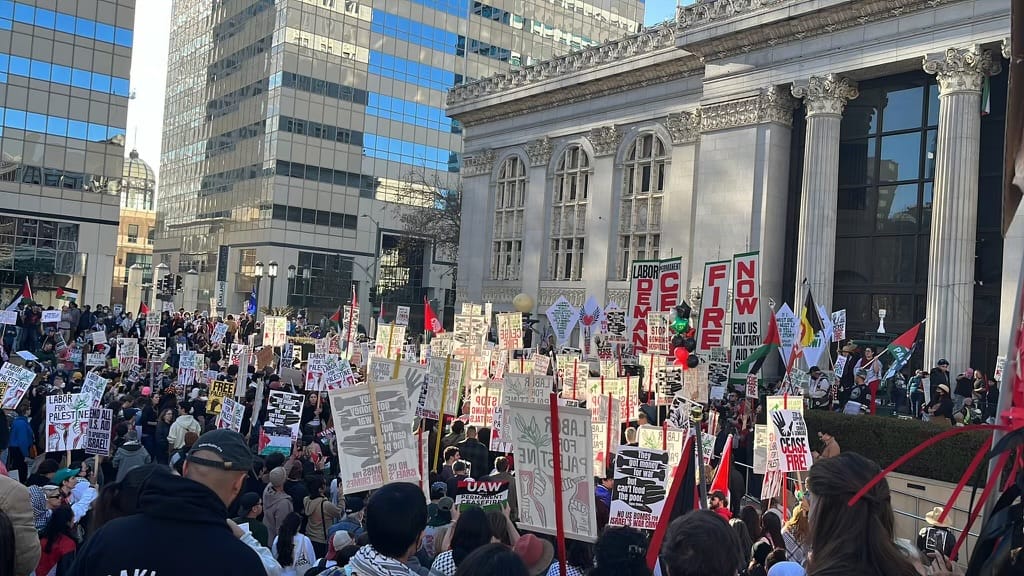
The Al-Aqsa Flood and the subsequent Israeli genocide, which began the fall of 2023, galvanized international and anti-imperialist solidarity across the world, including in the small ranks of the socialist movement in the United States. In those early months especially, members of Communist Caucus came together to discuss how we might leverage our existing organizing – its lessons, our relationships – in a changing context.
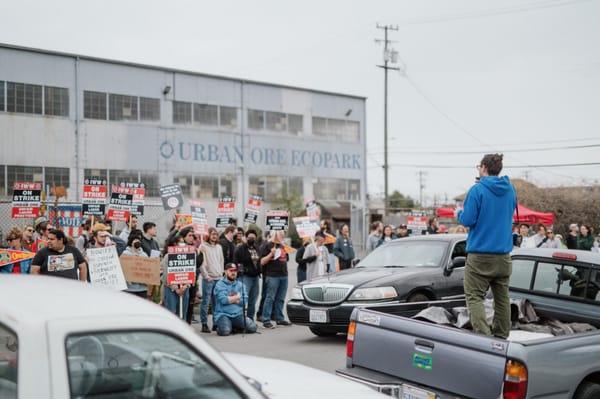
Our caucus has long understood the sort of mass work we most prize – rank-and-file action on the job, collective action in the neighborhood, and effective direct action in the streets – to not be a precondition to addressing larger political issues, so much as the means by which we might do so: places where new collectivities are born and a deeper kind of power can be developed. In many respects, our experience of organizing Palestine solidarity actions over the course of the last few years has both confirmed and refined that early hypothesis. In the intervening years, members of the caucus helped organize the only strike for Palestine in the United States; supported and developed the student encampments in spring 2024; helped build out direct action groups and campaigns such as Writers Against the War on Gaza and the boycott of SXSW; developed lasting organizations such as Labor For Palestine; spearheaded massive (and successful!) divestment campaigns in California; supported formations such as Workers in Palestine; contributed to the Pinnacle Tenant Union’s struggle against displacement in Israel and NYC, and much, much more.
Of course, more than two years into the genocide, the limits of what our movements have been able to accomplish are felt acutely, both in Palestine and also around the world, where the impunity of Zionism and American imperialism have emboldened viciously racist and counterrevolutionary forces operating in Minnesota, Venezuela, and elsewhere. We continue to grapple with questions of power and leverage, of fortifying people for fights that can involve severe – and amplifying – legal risks, and of the interplay between large street protests that consolidate common sense and the trench warfare of everyday organization where the needle is moved, albeit in a much more distributed and piecemeal fashion than we often wish.
Still, despite these limits, the sequence of the last few years has encouraged us to continue in the kind of political work we’ve prized and continue to refine and develop. Our early summary of our first conversations after October 7th also provide us with an image of internationalism that does not eschew local struggles, or reduce it to an act of solidarity-statement making or another round of marches and demonstrations. Rather, it is a matter of tangible connections between peoples and struggles, which flow from the kinds of organizing already underway where we live and work. It’s an internationalism that starts at home.
From the fall of 2023:
Like most active parts of DSA, members of Communist Caucus have been involved in the movement against Zionism and for Palestine solidarity — in movement groups, in campus organizations, and through protest and direct action. We have also been working to incorporate anti-imperialism and internationalism into our union work.
In some places, that has meant bringing our unions out to marches or making statements of solidarity. We have also been feeling the urgency of identifying places where we might exercise our power to stand in direct material solidarity with Palestinians.
Caucus members have been dedicated to building Palestinian solidarity within the labor movement by organizing against military contracts in higher education, bringing teachers unions into anti-Zionist coalitions, organizing (and winning) around the Palestinian Campaign for the Academic and Cultural Boycott of Israel (PACBI), planning to organize retail workers around the Boycott, Divestment, Sanctions (BDS) movement, and Blocking the Boat.
Commie Caucus members have developed a few concrete theses that we are holding on to in this moment, on the basis of this recent organizing experience:
- Mass work in our unions — tenant and labor — is not exclusively economic, but is a powerful, essential place from which we must practice our anti-imperialism and the politics of international solidarity. In many cases, comrades have already built organized bonds and infrastructures that can be further developed to meet this moment. Our unions are not only transmission belts to the places where “capital-P” Politics happens — they are organizations that can act politically, although they will not do so automatically in the direction of socialism, but only through concerted effort.
- Mass work and direct action to boost Palestinian solidarity comprise a powerful alternative to the dominant conception of internationalism as diplomacy. While peer-to-peer connections between comrade groupings around the world are important, as is a common analysis of anti-imperialism in our movements, an effective internationalism must center practicable solidarities and concrete action by the working class. Therein lies the potential, however unpracticed at our disorganized juncture, for a sustained movement against US imperialism at a mass scale.
- Moving our unions into the chorus of ceasefire calls is important for their political development and for advancing the wider discursive battle, but our unions also can potentially disrupt the reproduction of Zionist occupation. Our organizations are the means by which we might stand in direct material solidarity with Palestinians. While this might involve things like pension divestment work, many workplaces — particularly in higher education, cultural work, logistics, and manufacturing — provide additional points of leverage that bear directly and indirectly on Zionist political and military power.
- Engaging in international solidarity action need not distract from questions of class power and organization. International solidarity actions provide opportunities to build and develop power in two ways. First, by developing new alliances, stronger analysis, and practicing democratic deliberation and decision-making. Second, by growing the organizational capabilities for taking action outside of sanctioned or “normal” timelines. To give some examples: The Oakland Education Association saw their solidarity statement approved with a strong democratic mandate, despite right-wing backlash. In our tenant unions, such as the Bay Area Tenant and Neighborhood Councils (TANC), participation in these actions has forced us to develop flexibility toward regular participation in movement politics.
- Orienting rank-and-file workers toward a militant rank-and-file culture has been key to our limited success. Rank-and-file militancy has relied on and developed, effective, and proven workplace leadership; it has provided a strong mandate to move our unions into action; and it has provided evidence for our assertion that we must build relationships in moments of quiet relationships that can be activated and mobilized in moments of mass movement activity. To a strong degree, the transition between these two moments has hinged on a strong internal union culture.
- Organizers have sometimes been surprised to find that there are union members who are enthusiastic about pursuing international solidarity when they have otherwise not been involved in union activities. We must take seriously the politicizing potential of this moment, and act on it to bring more rank-and-file members into active organizing roles.
- This moment makes clear the necessity of a popular internationalism, one that takes anti-imperialist solidarity as the basis of improving the situation of the dominated and exploited in this country, too. Workers are already acting on the relationship between the local and the international by articulating connections between their workplace issues — such as teaching conditions, research funding, free speech, academic freedom, the safety of journalists, health and safety provisions (as seen with dockworkers vis-à-vis community pickets) — and the operation of the US war machine.
- Ties between community and labor organizations in solidarity with Palestine need to become more durable, especially in terms of keeping consistent relationships with rank-and-file workers — like, for instance, those in the International Longshoremen’s Association (ILA) or International Longshore and Warehouse Union (ILWU). At the moment these relations (in most cases) do not exist, unless members from all organizations happen to be connected through a body like DSA. DSA should be built out in a way to facilitate more of these connections, but we also need to develop broad movement organizations — as East Bay DSA has in Oakland, California. with Labor for Palestine — to continue facilitating these connections.
- On the cultural front, we’ve learned that“the struggle over language is a struggle with management. Culture is a terrain of struggle, both inside of our places of work and in independent projects. How terms and conditions are defined may escalate quickly, transforming from something staged on social media into a pitched battle between culture workers and management.
- There is a tension between the urgency we feel in the moment and the reality of the enduring work that lies ahead to build decisive strength on the side of Palestinian solidarity. The energy demanded of us now, and the patience and stamina required to change the balance of power between classes, must be named. We must find ways to meet the moment while also keeping our eyes fixed on our long-term objectives.
- The Palestinian struggle has been playing a vanguard role. It is a rendezvous point for all of us working to build a revolutionary political culture. It pushes us forward, toward unity, and toward a more sophisticated analysis and more effective practice.